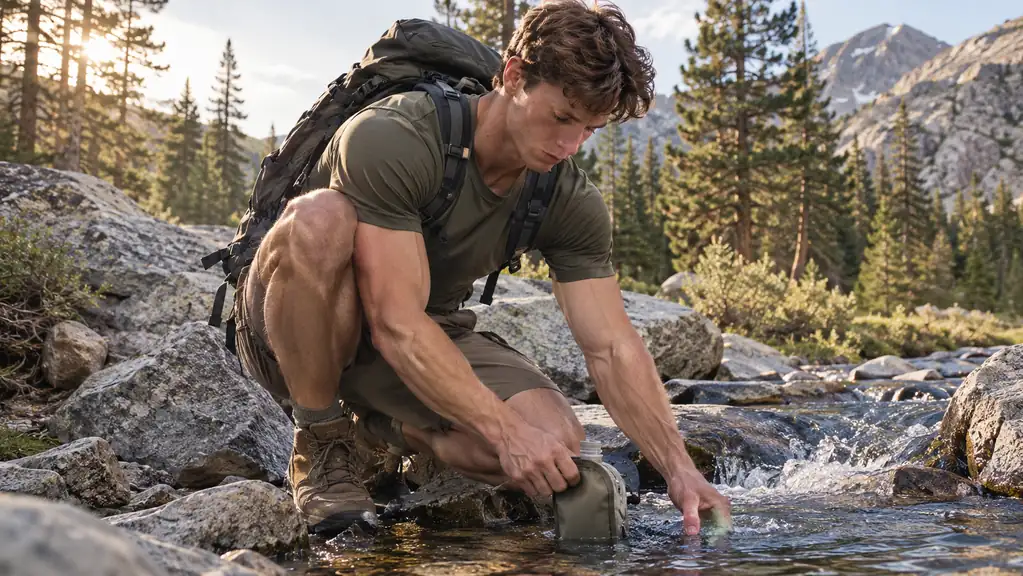
The first time I used the Sawyer Mini for real, I was standing on a gravel bar along the Bitterroot, holding a pouch of river water that I was about to drink. I have hiked for about thirty years, and for most of that time I carried a heavy pump filter and grumbled about it. When I retired my old gear this spring, I wanted something lighter, and the Sawyer Mini kept coming up in every conversation at the trailhead. So I bought one in the first week of April, and I have carried it on every backpacking trip and long day hike since.
Seven months later, after a full season of Montana streams, snowmelt creeks, and one very dubious stock pond, here is what I think: the Sawyer Mini is not perfect, but it is the filter I trust enough to keep in my pack. It is small enough that I forget it is there, light enough that I never resent carrying it, and simple enough that my husband Tom uses it without asking me for instructions.
The Quick Verdict
A dependable, lightweight filter that earns its place in any pack. Plan for slow flow and learn to backflush before you need it.
Amazon Check Today's Price →The filter that has ridden in my pack all season
If you want one less thing to think about on the trail, the Sawyer Mini is a solid choice. I have used mine on every trip this summer.
Amazon Check Today's Price on Amazon →How I've Used It
I bought the Sawyer Mini in the first week of April, right after I retired my old pump filter. Since then it has been on three backpacking trips of two to three nights each, one overnight shakedown in May, and every long day hike where I knew I would be out for more than a few hours. On day hikes I carry it in a small daypack, and on overnight trips it lives in the top pocket of my Osprey Renn 50.
My routine is simple. I fill the included 16-ounce pouch from the cleanest water I can find, screw on the filter, and squeeze. When the pouch is empty, I refill and go again. For a solo day hike, one pouch fill is usually enough for a couple of hours. For a two-night trip with Tom drinking from the same filter, I plan for several fills a day, especially in the heat of August.
On the overnight shakedown in May, in the Sapphire Mountains east of Missoula, I nearly left the filter at home. The trip was short, and I knew there was a spring near camp, so the extra 41 grams felt like something I could skip. I packed it anyway, out of habit. Good thing I did. The spring was running low that weekend, and the creek below it was the only reliable water. I filtered two liters for dinner and another liter and a half for coffee and the hike out. That trip set the pattern for the whole season: the filter goes in the pack before the map does, and it stays there between trips. By August, when the Bitterroot was running warm and low, Tom and I were each going through three or four pouch fills a day on long hikes. I learned to filter whenever we stopped, while I was already sitting on a log, rather than waiting until my mouth was dry and the sun was high.
After every trip, I backflush with the included cleaning plunger. I fill the plunger with clean water, attach it to the filter, and push water backwards through it until it runs clear. That routine takes about two minutes at the kitchen sink, and it has kept the filter flowing all season.
What the Specs Actually Say
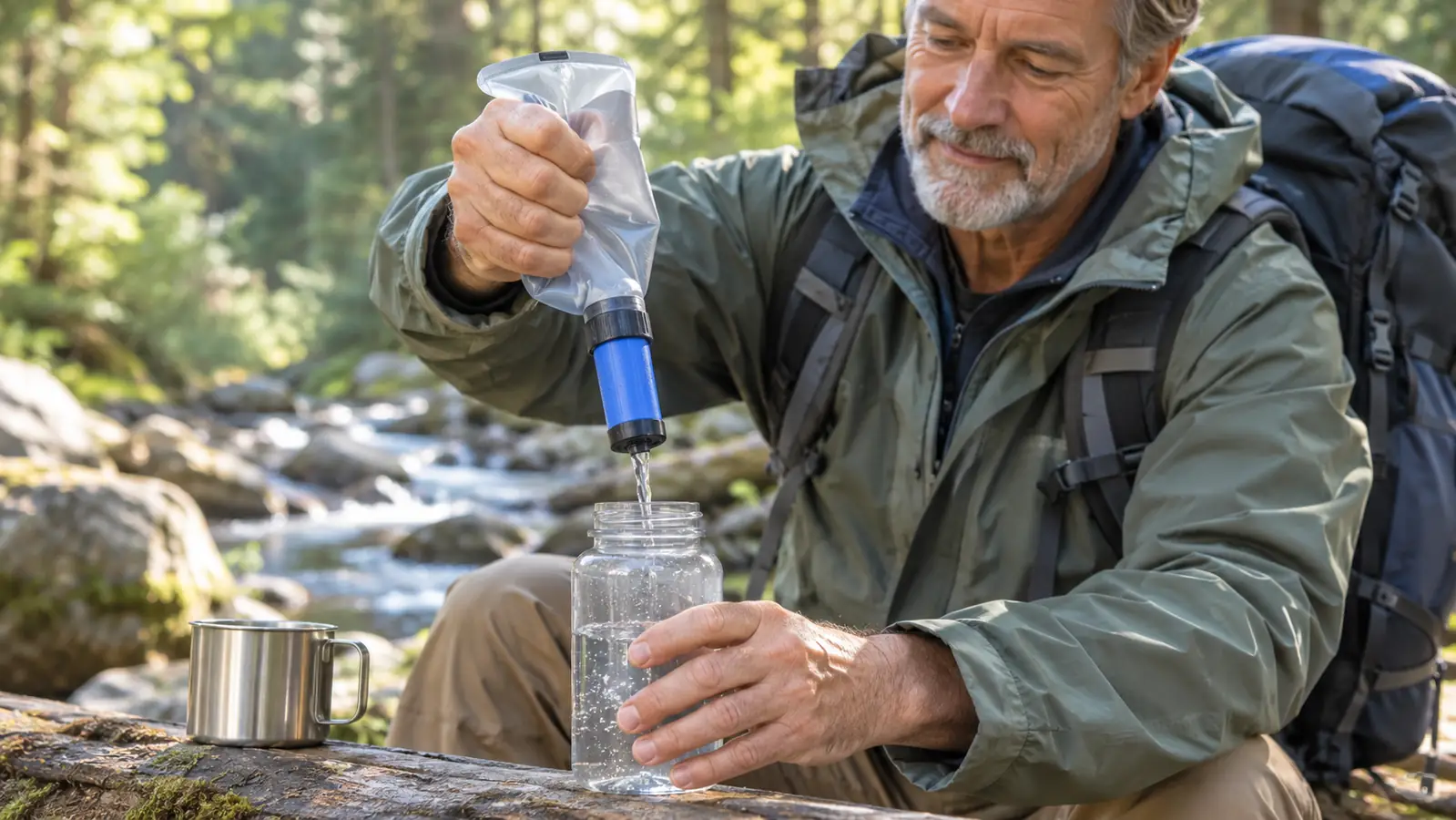
The Sawyer Mini uses a hollow fiber membrane with a 0.1 micron absolute filter. The listed capacity is 100,000 gallons, which is a number I will never personally verify, but it tells you the company expects this thing to last. The whole filter weighs 41 grams, which is about an ounce and a half. I notice it in my pack about as much as I notice a spare pair of socks, which is to say, not at all.
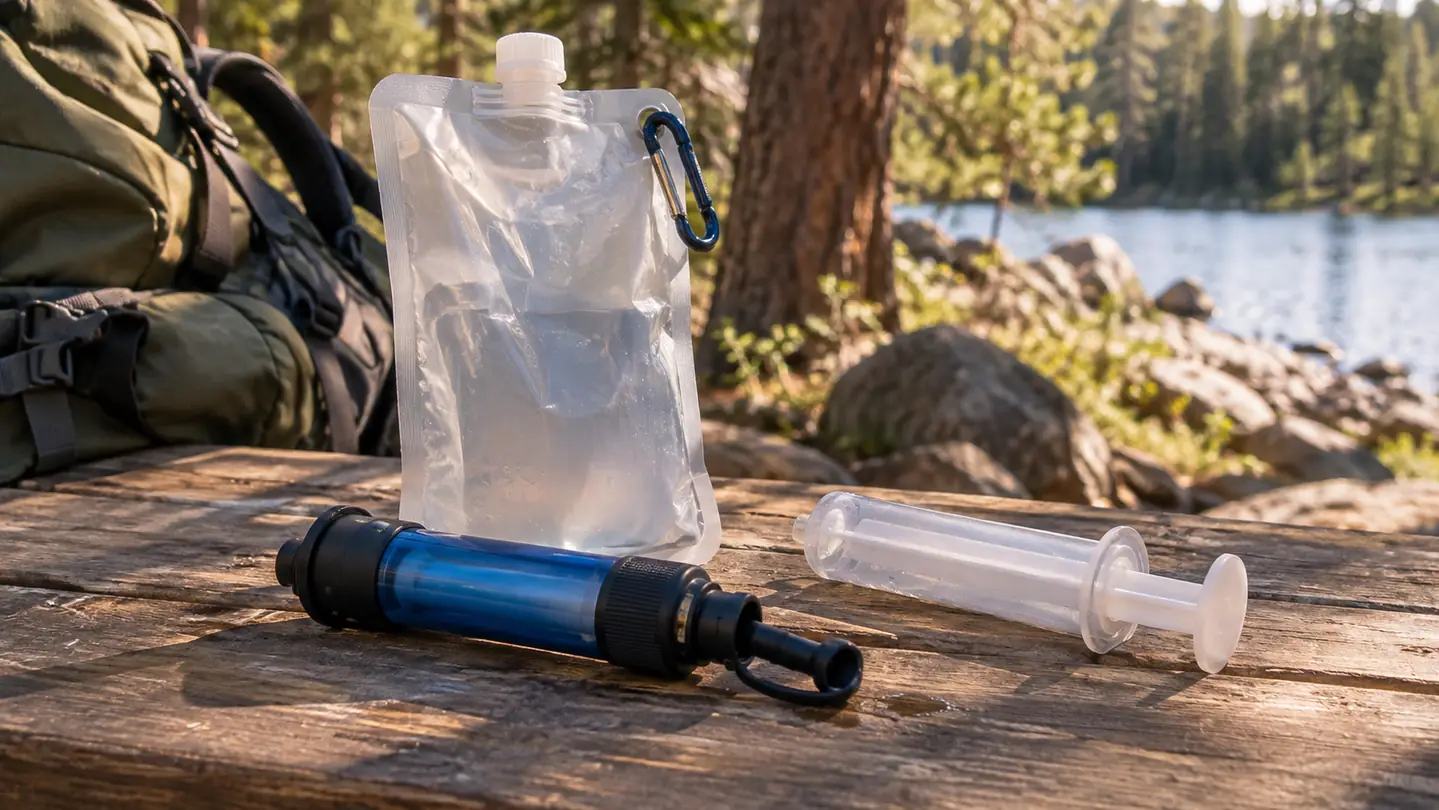
The included components are the filter itself, a 16-ounce pouch, a drinking straw, and the cleaning plunger. The filter attaches to the pouch, to standard 28 mm disposable water bottles, and to hydration packs, or you can use the straw to drink directly from a water source. I have used the pouch most of the season. I have also used it with a spare squeeze bottle when I wanted to filter a larger amount for camp cooking.
The manufacturer says it protects against 99.999999% of bacteria, including Salmonella, Cholera, and E. coli, and removes 99.9999% of protozoa such as Giardia and Cryptosporidium. It also removes 100% of microplastics. What it does not do is remove viruses or chemicals. I want to be clear about that, because I have seen people at the trailhead assume that any filter makes any water safe. It does not. I still choose my water sources carefully, especially in areas with livestock or heavy use.
I tested the drinking straw once, early in the season, at a small spring in the Rock Creek drainage south of town. You kneel, put the straw in the water, and drink straight through the filter. It works exactly as described, and it is the closest thing to drinking from a spring unfiltered that I have found in thirty years of hiking. I do not use it often, because kneeling on a rocky bank is harder on my left knee than it used to be, but it is good to know it is there. The 28 mm bottle compatibility turned out to be the feature I use most after the pouch itself. I keep a spare squeeze bottle in my daypack, and on hot days I drink a bottle on the drive to the trailhead and refill it all day from the filter. The hydration pack connection I have not tried, because I still prefer a bottle on my hip, but a friend clipped one to her pack hose and said it was simple enough.
How It Performed Over the Season
The first thing I noticed was the flow. The Mini is slower than my old pump filter, and there is no point pretending otherwise. When I am filtering two liters of water for dinner and breakfast, I start early and let it work while I set up camp. It is not a filter for someone in a hurry.
The second thing I noticed was how easy it is to maintain. My old filter needed parts and patience. The Mini needs a backflush after each trip, and that is about it. I have not had a clog that a good backflush did not cure, and I have put it through some water I should not have.
The September trip is the one that tested me. We camped above a beaver pond on the upper reaches of a creek I will not name, because I do not want anyone else drinking from it. The water was warm, brown, and full of silt, and I knew better. But it was the only water within a mile, so I filtered it anyway. The flow slowed to a trickle by the second liter, and I spent a long evening squeezing water for dinner. When I got home, I backflushed at the kitchen sink, pushing water through until it ran clear, and the filter was back to normal for the next trip. It handled a mistake I should not have made, and it forgave me. Cold water is the other thing that slows it down. On a frosty morning in early October, with the air around freezing, the first liter took noticeably longer than it did in July. The water was fine, just cold, and the filter does not like cold. I have learned to filter the evening before when I know the morning will be cold, or to fill the pouch and let it sit in the sun for a few minutes before squeezing.
The third thing I noticed was the weight, or rather, the lack of it. At 41 grams, the Mini disappears into my pack. On long day hikes, I carry it in my daypack and barely remember it is there until I need it. That is the whole point of a filter this small.
I also appreciate that it works with a standard 28 mm disposable water bottle. That single detail has saved me more than once. When the pouch is already full and I need more water for the hike out, I can grab any bottle from the car and put it to work. It is the kind of flexibility that makes gear feel like it is on my side.
What I'd Change
The flow rate is my biggest complaint. The manufacturer lists a maximum flow rate that I would describe as optimistic for real trail conditions. When the water is clear and the filter has just been backflushed, it flows fine. When the water is silty or the filter is due for a backflush, it slows to a trickle. I have learned to plan around it, but I would not want to filter for a group of four with this filter alone.
I timed myself once, out of curiosity, on a warm afternoon in July. Two liters of clear creek water took about nine minutes of steady squeezing, including refills. That is not bad for one person, but it is slow work when you are tired at the end of a long day. On that same trip, a friend with a gravity filter had dinner water ready while I was still on my second pouch. I do not need that speed for my own trips, but I understand why some hikers prefer a different system. What surprised me was that the flow did not improve much with practice. I had hoped the filter would loosen up as it got broken in, the way a new boot does. It did not. It was slow in April and it is still slow in October, which means the slowness is not a defect that wears off. It is just the nature of a filter this small.
The included pouch is also a little small for camp use. Sixteen ounces is fine for a drink on the trail, but for cooking and washing up, I end up doing several fills. On a two-night trip, that means a lot of standing around squeezing.
I solved the pouch problem by carrying a spare squeeze bottle, which holds more and squeezes faster than the included pouch. The filter threads onto it the same way, so switching takes about ten seconds. I picked up the bottle at a gear swap this season, and it has become a permanent part of my kit. If Sawyer ever sells a kit with a larger pouch, I would buy it in a minute. Until then, the spare bottle lives in my daypack and I do not think about it.
And I will say this plainly: the Mini is not a substitute for treating water that may contain viruses. If I were hiking somewhere with questionable sanitation, I would want a different system. For the mountain streams and lakes of western Montana, it is exactly right.
What I Liked
- Weighs just 41 grams, so it disappears into a pack
- Rated for 100,000 gallons, which should be a lifetime of hiking
- Works with the included pouch, standard 28 mm bottles, and hydration packs
- Simple to backflush with the included cleaning plunger
- Removes 100% of microplastics, which matters more every year
- Inexpensive enough to keep a spare in the car
Where It Falls Short
- Flow is slow, especially in cold or silty water
- The included 16-ounce pouch is small for camp use
- Does not remove viruses or chemicals, so it is not for every water source
- You have to stay on top of backflushing or the flow drops off
At 41 grams, the Mini disappears into my pack. That is the whole point of a filter this small.
Who This Is For
The Sawyer Mini is for the hiker who wants clean water without carrying a brick. If you are a day hiker who wants the security of a filter in your pack, or a weekend backpacker who filters for one or two people, the Mini is a great fit. It is also a good choice for someone who wants a backup filter that takes up almost no room.
It is especially good for hikers who use hydration packs, because the filter attaches directly to the hose. And for anyone who has ever stood at a trailhead and realized they left the pump at home, the Mini is small enough to live permanently in a pack pocket. I keep mine in the top pocket of my Renn, and I never have to think about whether I packed it.
Who Should Skip It
If you filter for a group of three or more on every trip, the slow flow rate will test your patience. A gravity filter or a faster pump will get dinner on the stove sooner. If you hike in areas where viruses are a real concern, the Mini is not the right tool, because it does not remove them. And if you want a filter you can ignore for months at a time, this one will punish you with a sluggish flow until you backflush it.
I will also say that if you are the kind of person who hates fiddly maintenance, the Mini requires a little discipline. The backflush is easy, but you have to actually do it. I do mine after every trip, and it takes two minutes. Skip it for a season and you will be standing at a stream wondering why the water is barely moving.
Seven months in, this is the filter I trust
If you want one less thing to think about on the trail, the Sawyer Mini has earned its place in my pack. It might earn a place in yours.
Amazon Check Today's Price on Amazon →